Viking Halvar Tunic: What Makes a LARP-Ready Short Robe
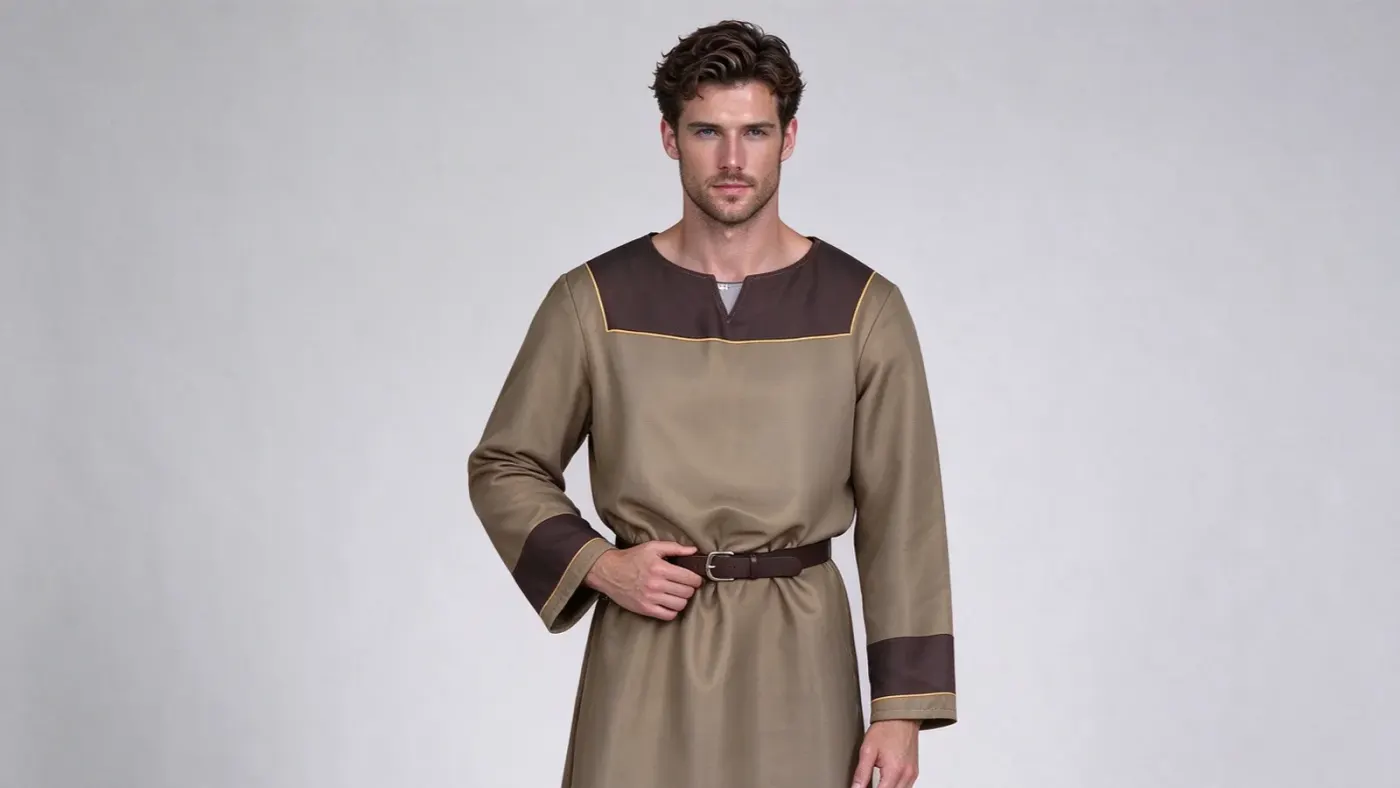
The short Viking tunic is one of the most useful pieces in the historical costume category. It is simple enough to produce at a reasonable price, flexible enough to fit a wide range of buyers, and specific enough to read as Viking rather than generic medieval. The version that works best for LARP and ren fairs is not a costume-shaped sack; it has a deliberate yoke, a controlled hem and enough weight to hang properly.
Why the short robe works for LARP
LARP costumes need to survive movement: running, kneeling, carrying props and wearing a belt for hours. A knee-length tunic with side splits gives freedom in the legs and keeps the fabric from bunching at the hip. It also layers easily over trousers and under a cloak, which makes it a core piece rather than a one-off look.
The short length is practical for buyers too. It uses less fabric than a floor-length robe, ships in a smaller carton and fits more body types without a complex grade. That makes it a strong entry price point that still looks intentional.
The details that sell it
The sample we reviewed uses a contrasting yoke across the shoulders and chest, a narrow gold piping line, contrasting cuffs and a split hem. Those details do a lot of work:
- Yoke panel — frames the face and adds a historical layer without embroidery.
- Piping — defines the yoke and cuffs; it must be stitched, not glued, and should not pucker.
- Contrast cuffs — protect the sleeve edge and visually balance the yoke.
- Split hem — improves movement and prevents the tunic from riding up when belted.
- Belt — a simple leather-look belt changes the silhouette; confirm whether it is included.
A plain tunic can be just as convincing, but it needs better fabric and a cleaner cut to carry the look. The detailed version is easier to merchandise because the yoke reads at a distance and in photographs.
Fabric and weight
The source style uses a polyester fabric that is described as suitable across seasons. For a tunic, the key is a matte surface and enough body to fall from the shoulder without clinging. A light, shiny polyester reads as a costume; a brushed or textured weave reads closer to wool or linen.
If the tunic will be used for LARP in warm weather, a lighter weight with a linen-look texture is more comfortable. For cold-weather events, a mid-weight fabric that layers over a shirt is better. Ask for a swatch and check how it creases: a fabric that wrinkles sharply looks historical; one that springs back looks synthetic.
Fit and layering
The tunic should be loose enough to layer a shirt underneath but not so wide that the yoke collapses. Check the shoulder width, the armhole depth and the sleeve length. A tunic that is too short in the sleeve looks like a failed shirt; one that is too long bunches at the wrist.
Because the style is belted, the waist measurement matters less than the chest and shoulder. Still, confirm the hip width so the tunic does not pull across the stomach when sitting. For a unisex style, publish a size chart with body measurements and note the intended fit: close, relaxed or oversized.
Care and durability
LARP costumes get dirty. A tunic that can be machine-washed cold and hung to dry is easier to own than one that requires dry cleaning. Check that the piping and contrast panels are colourfast, and that the belt does not transfer dye onto the fabric. If the style has metal hardware, confirm it will not rust after rain.
Buying checklist
- Does the yoke sit flat across the chest and back?
- Is the piping stitched and free of puckers?
- Are the side splits deep enough for walking and kneeling?
- Is the belt included, and does it fit the largest size?
- Does the fabric have a matte, textured surface rather than a shine?
- Can the tunic be washed without losing shape or colour?
The Viking collection includes tunics, cloaks, belts and trousers that can be merchandised as a complete outfit. For a custom colourway or a private-label run, send the reference and size range through the inquiry form.
FAQ
What is a Halvar tunic?
Halvar is a style name used for a short Viking-style tunic with a contrasting yoke, cuffs and a belted waist. The name is commercial rather than historical; the construction is inspired by early medieval tunics.
Is a short tunic suitable for LARP?
Yes. A knee-length tunic with side splits allows movement, layers over trousers and works with a belt and cloak. Choose a matte, washable fabric and check that the armholes and shoulders allow you to raise your arms.
What should I wear under a Viking tunic?
A linen or cotton shirt and loose trousers are the usual layers, with a belt at the waist and boots or leg wraps. In cold weather, add a cloak and a wool or fleece layer underneath.
Planning a seasonal or private-label range? Send us your brief and our team will reply with fabric, sampling and lead-time options.