Tudor Nobleman Costume: Black Cloak, Printed Shirt and Royal Silhouette
Black is the hardest colour to make interesting in a costume. It absorbs detail, hides construction and turns a photograph into a silhouette. The Tudor nobleman look solves this by layering texture: velvet against matte fabric, silver chain against black, a white damask sleeve against a dark coat. The result reads as wealth before the viewer can name a single historical reference.
The black-on-black palette
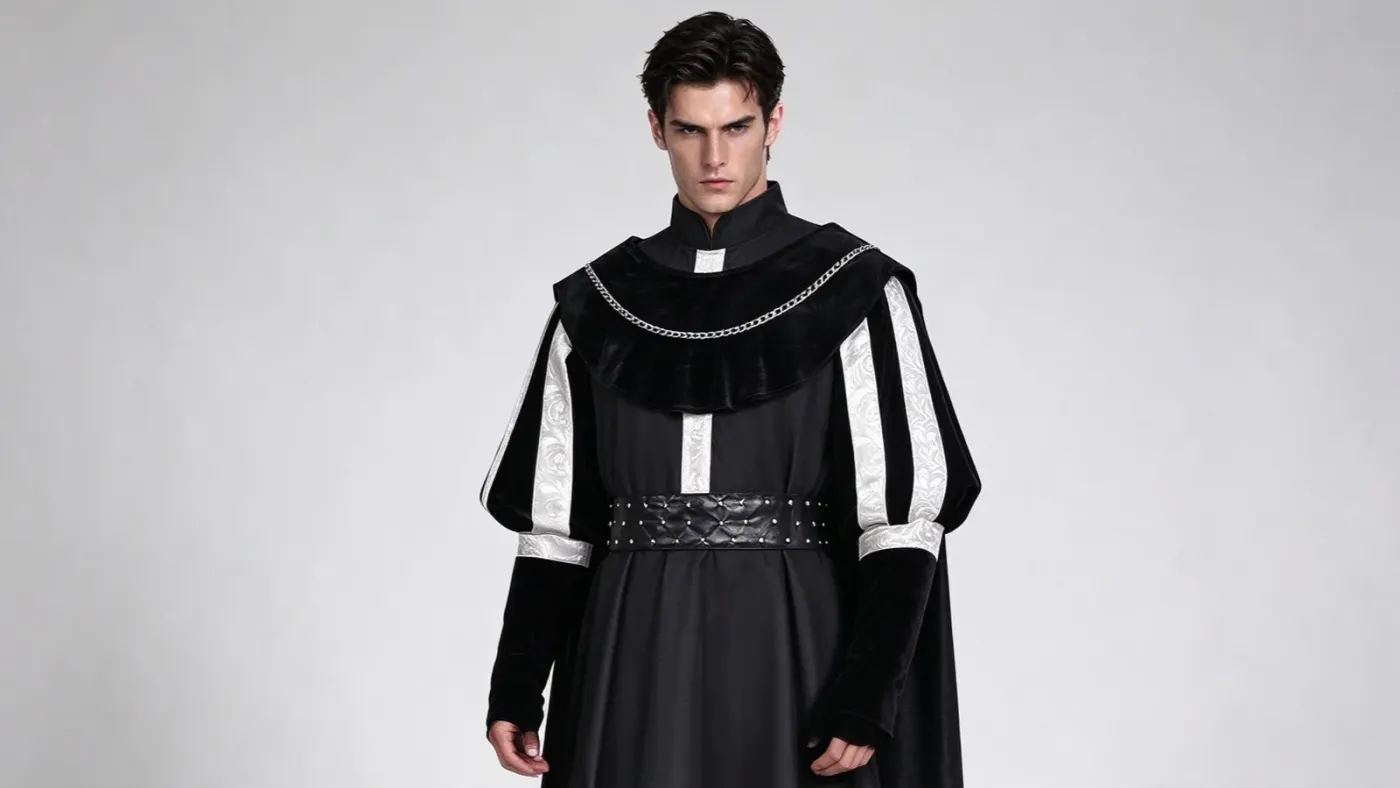
A convincing nobleman costume is not one black fabric. It is a mix of surfaces with different levels of sheen. The sample we reviewed combines a matte black coat, a velvet shoulder cape with a soft pile, satin-finish damask sleeve panels and a studded belt. Under stage light, each surface catches the light differently, which keeps the costume from flattening into a shape.
If you are sourcing a similar style, ask for the fabric composition of each panel, not just the outer shell. A cheaper version may use the same polyester for every piece, which looks uniform and dull. A better version varies the weave and pile while keeping the colour matched.
The velvet shoulder cape
The shoulder cape is the piece that creates the Tudor silhouette. It sits over the shoulders like a wide collar, often with a chain or braid along the edge, and falls to the upper arm. It should be structured enough to stand away from the body but soft enough to move.
Check the attachment: a cape that is only tacked at the neckline can shift or pull. It should be anchored at the shoulder seams and finished cleanly inside. The chain trim should be stitched at regular intervals, not glued, and it should not dig into the neck when the wearer turns their head.
Printed and damask sleeves
The sleeve panels are the second focal point. A white or silver damask pattern against black gives the eye somewhere to rest and suggests an expensive underlayer. The pattern should be scaled to the sleeve: a large repeat gets cut off at the seam and looks accidental; a small repeat reads as texture.
If the sleeve is made of a separate panel, confirm that it is breathable and that the seam does not rub under the arm. On a stage costume, the sleeve may be visible only from the front, but the back and side views matter for photography and for the audience.
Belt, trousers and boots
The studded belt defines the waist and breaks up the black. It should be wide enough to sit over the coat without rolling, and long enough to fit the largest size. If the belt is not included, state that clearly; buyers often assume a shown accessory is part of the set.
Trousers should be dark, straight or slightly tapered, and long enough to cover the boot top. The sample uses black trousers that match the coat. For a stage look, a boot with a slight heel improves posture and makes the silhouette taller; for comfort at a party, a flat boot is easier to wear.
Who buys it
This is a crossover piece. It works for Halloween, Renaissance fairs, theatrical productions, photo shoots and Gothic or dark-academia events. It also sells to cosplayers who want a nobleman or villain look without a licensed character. That breadth is useful for a seasonal range because the same style can be merchandised in several ways.
For photography, style it with a crown, a signet ring, a goblet or a sword. For retail, show the costume with and without the cape so buyers understand the layers. For theatre, confirm that the cape can be removed quickly if the actor has a costume change.
Fit notes
The coat should fit cleanly across the shoulders and allow the arms to cross in front. The cape adds bulk at the neck, so check the collar opening with the cape on. The sleeve length should reach the wrist bone; a damask panel that stops short looks like a cuff rather than an undersleeve.
If the costume is unisex, publish measurements rather than relying on a letter size. The waist belt and shoulder cape are the two areas where a unisex cut behaves differently on different bodies.
Buying checklist
- Are the black fabrics varied in texture, or all the same shiny polyester?
- Is the shoulder cape anchored at the seams and cleanly finished inside?
- Is the chain trim stitched at intervals and comfortable at the neck?
- Does the damask pattern scale correctly on the sleeve?
- Is the belt included, and does it fit the full size range?
- Can the wearer raise their arms and turn their head without the cape pulling?
Our Tudor and Renaissance collection includes nobleman coats, capes, doublets and corsets. For a private-label program, send the colourway, size range and target price through the inquiry form.
FAQ
What makes a Tudor nobleman costume look authentic?
Layered textures, a structured shoulder cape, a defined waist and period-appropriate details such as chain trim, damask sleeves and a wide belt. Avoid a single uniform black fabric, which flattens the silhouette.
Can the shoulder cape be removed?
It depends on the construction. Some capes are stitched permanently at the shoulder seams; others attach with hooks or snaps. Confirm the attachment method before ordering, especially for theatre productions with quick changes.
Is this costume suitable for Renaissance fairs?
Yes. The Tudor silhouette works for Renaissance fairs, theatrical roles and Halloween. Check the event’s costume rules if weapons or props are involved, and choose boots that are comfortable for walking on grass.
Planning a seasonal or private-label range? Send us your brief and our team will reply with fabric, sampling and lead-time options.