Hooded Wizard Robes: Velvet, Grey-Green and Full-Length Drama
The wizard robe is one of the few costumes that works for almost every customer: kids, adults, theatre groups, churches and cosplayers. It is also one of the easiest to make badly. A cheap robe looks like a bedsheet with a hood; a good one has enough weight to fall in folds, a hood that stands instead of collapsing, and sleeves that move when the arms do.
Why velvet makes the look
Velvet gives the robe its authority. The pile absorbs light, so the fabric reads as deep and dense rather than flat. It also catches stage lighting along the folds, which creates the shadows that make a wizard silhouette dramatic. A smooth polyester does not do this; it looks like a costume from a distance and a curtain up close.
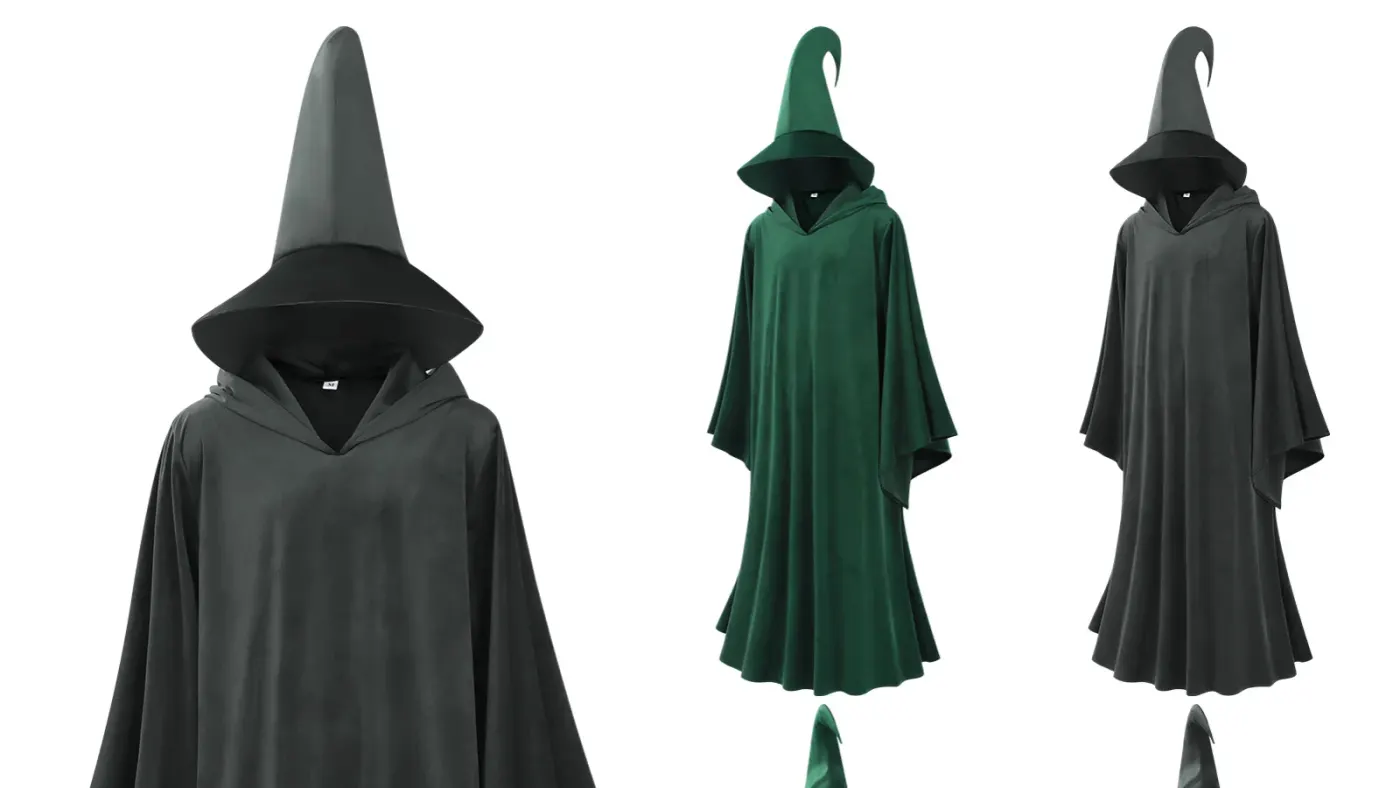
The sample we reviewed is a grey-green velvet robe with a pointed hood and wide bell sleeves. The colour is a useful alternative to black: it reads as mysterious under warm light, photographs well against autumn foliage, and is less common than the standard black robe. A deep green or charcoal is equally versatile.
Hood shape and structure
The hood is the defining feature. It should stand up at the back and frame the face without falling forward. That requires a shaped pattern, not a simple rectangle gathered at the neck. Check the height of the point, the depth of the opening and the seam placement: a centre-back seam is normal, but it should not pucker at the tip.
If the hood is lined, the lining should be smooth and colour-matched. An unlined hood can be scratchy and may show through at the point. For a theatrical robe, a slightly stiffened hood holds its shape under lights; for a comfortable party robe, a softer hood that can be pushed back is more practical.
Sleeve volume and movement
Wizard sleeves are usually wide bells that fall from the elbow or the shoulder. They look dramatic when the arms are raised, but they can also get in the way of eating, drinking and carrying props. Check the opening circumference: a very wide sleeve is photogenic but impractical for a party; a moderate bell is easier to wear.
Ask the model to raise both arms and turn. The sleeve should not pull the shoulder seam or expose the underarm. If the robe has a deep V-neck or an open front, check that the sleeve weight does not drag the neckline sideways.
Length and fabric weight
A full-length robe should reach the ankle or the floor, depending on the look. Floor-length is more dramatic but collects dirt and can be a trip hazard; ankle-length is easier to walk in and fits more heights. For kids, a shorter robe is safer and can be worn for more than one season.
Weight matters. A heavy velvet robe feels expensive but can be tiring to wear for hours. A mid-weight velvet with a soft backing is usually the best compromise. Check the hem finish: a simple turned hem is fine for a costume, but a flimsy hem will drag and fray.
One size or a size range?
Many wizard robes are sold as one size, which is convenient for a Halloween range but can fit poorly at the extremes. A one-size robe may be too long for a shorter wearer and too tight across the shoulders for a larger one. If you are buying for retail, consider a size range or a shorter and longer version.
If the robe is one size, publish the measurements: chest, shoulder, sleeve, length and hood height. Add a note on the intended height range. That reduces returns and helps customers choose a robe that will actually look like the photos.
Styling and accessories
The robe does most of the work, so accessories should be simple: a staff, a wand, a belt, a pouch or a spell book. A rope belt changes the silhouette and keeps the robe from looking like a nightgown. A wide-brimmed hat can replace the hood for a different character, but it is not necessary.
For photography, use side light to bring out the velvet pile and a dark background to separate the hood. For retail, show the robe on a model of average height and on a taller model if possible, so customers can judge the length.
Buying checklist
- Does the hood stand up without falling forward?
- Is the velvet pile dense and evenly coloured?
- Are the sleeves wide enough to look dramatic but easy to wear?
- Is the length appropriate for the intended height range?
- Are the seams and hem finished cleanly inside?
- Is the robe available in more than one size or length?
Our wizard and fantasy collection includes hooded robes, cloaks, hats and staffs. For a private-label colourway or a theatrical order, send the brief through the inquiry form.
FAQ
What fabric is best for a wizard robe?
A mid-weight velvet or velour gives the best drape and photographs well under stage light. A smooth polyester is cheaper but looks flat. Check the pile density and the backing weight before ordering.
Are wizard robes one size?
Many are, but fit varies. Ask for chest, shoulder, sleeve and length measurements, and choose a size range if you need to fit a broad customer base. A rope belt can adjust the waist but not the shoulders.
How do I care for a velvet wizard robe?
Follow the care label. Many velvet robes are dry-clean only or hand-wash cold. Store them hanging with space so the pile does not crush, and steam rather than iron directly.
Planning a seasonal or private-label range? Send us your brief and our team will reply with fabric, sampling and lead-time options.