Dirndl Size Grading for EU Retailers
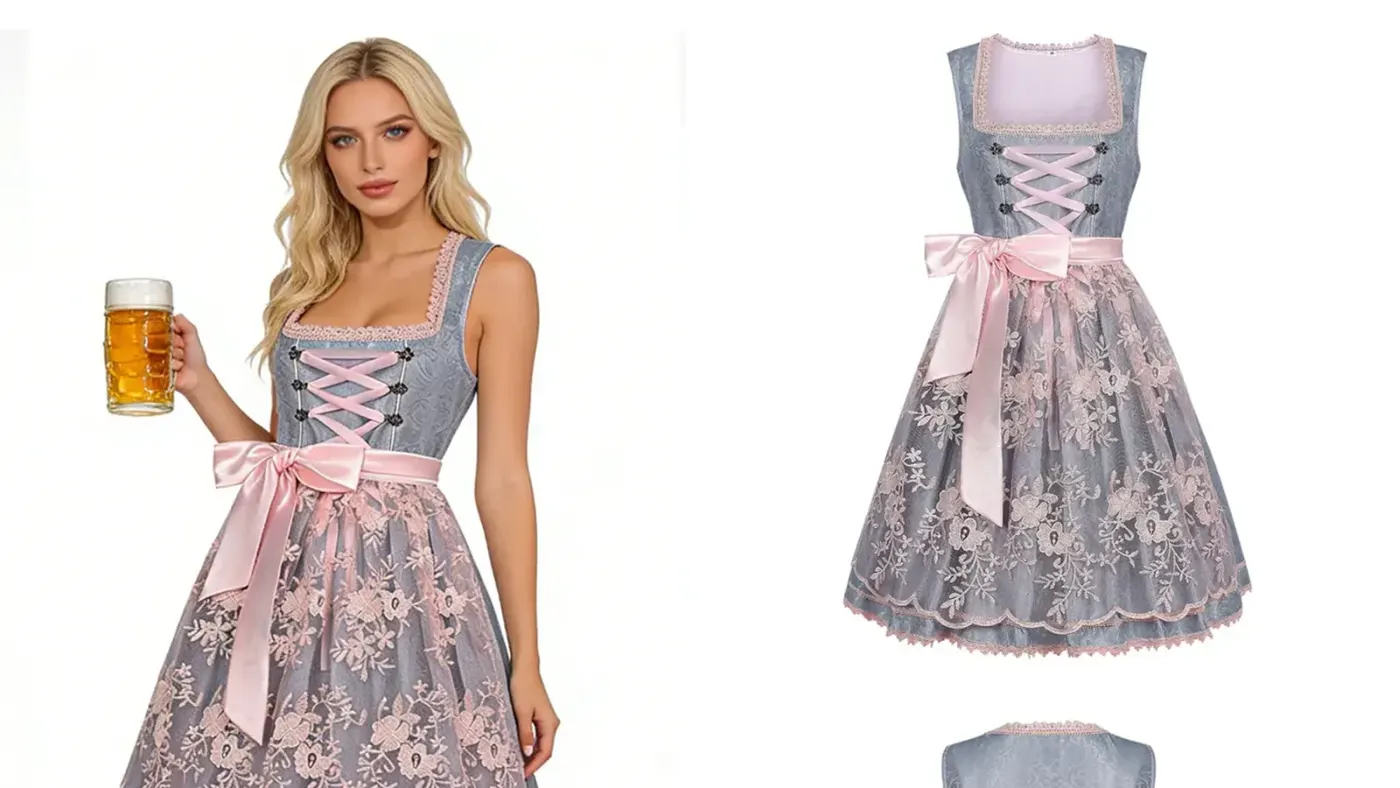
A dirndl is not a dress with a size label. It is a fitted bodice, a skirt and an apron that have to work together, and the bodice is worn close to the body with a blouse underneath. That is why an EU retailer can stock a size run that looks correct on paper and still get returns at 38 and 44. The grading has to follow the construction, not only the bust measurement.
This guide explains how we approach dirndl sizing for EU buyers, how the letter sizes we list relate to European sizes, and what to confirm before a bulk order. It is written for buyers building an Oktoberfest range, not for consumers choosing a single dress.
Why dirndl sizing is different from dress sizing
A standard dress has ease built into the pattern: the wearer can choose a size by bust or hip and the garment still hangs correctly. A dirndl bodice is designed to sit snugly, with the blouse providing the visual ease at the neckline and sleeves. If the bodice is graded only by bust circumference, the waist, underbust and armhole can drift, and the apron waistband no longer sits where the customer expects.
The skirt adds a second variable. A dirndl skirt is usually gathered or pleated and attached to the bodice; its length is a design choice (knee-length, midi or longer) rather than a body measurement. When you compare suppliers, compare skirt length as a separate specification, not as part of the size grade.
EU sizes and our S–5XL range
European dirndl sizes are commonly sold from EU 32 to EU 52, with 36–44 covering the core retail range. Our stock dirndls are listed in letter sizes from S to 5XL. The table below is an indicative bridge, not a substitute for the measurement chart on each product page.
| EU size | Letter size | Typical retail role |
|---|---|---|
| 32–34 | XS | Petite or junior fit; often special order |
| 36 | S | Core small |
| 38 | M | Core medium — usually the top seller |
| 40 | L | Core large |
| 42 | XL | Core XL |
| 44 | 2XL | Extended core |
| 46 | 3XL | Plus range entry |
| 48 | 4XL | Plus range |
| 50 | 5XL | Plus range top |
The bridge is approximate because European retail sizing is not harmonised. A German 38 and an Italian 38 are not the same body. Use the centimetre measurements — bust, underbust, waist, hip and bodice length — as the contract, and treat the EU and letter labels as merchandising aids.
The measurements that actually control fit
- Bust — measured at the fullest point, with the blouse the customer will wear. This sets the bodice width.
- Underbust — controls whether the bodice stays in place when the wearer moves; often the first point to fail on a graded-up size.
- Waist — the natural waist, where the apron band sits. A dirndl that is comfortable at the bust but loose at the waist will ride up.
- Hip — matters for the skirt and for stepping into a fitted bodice; check the hip on 2XL and above.
- Bodice length — the distance from the neckline to the waist seam. Grading this point proportionally keeps the waist seam in the right place.
- Armhole and sleeve — the blouse is usually separate, but the bodice armhole still needs enough depth for comfort.
For a size set, we recommend approving a fit sample in at least three sizes: the smallest, the middle and the largest. A single medium sample does not show how the pattern behaves at the ends of the run.
Grading rules we use
Grading is not uniform scaling. The bust, waist and hip grow at different rates, and the armhole and neckline need their own increments. For dirndls we review three things on every grade:
- Waist-to-bust balance — keep the waist suppression proportional so the bodice still hugs rather than tents.
- Apron band — the band and its closure should be re-checked at each size; a tie that works at S can be too short at 4XL.
- Skirt volume — pleat or gather density should be adjusted so the skirt does not become sparse at larger sizes.
If you need a size run beyond our stock range, we can grade a style from a tech pack or an approved sample. Custom grading usually starts at 100–300 pieces per style and color, depending on fabric and trim changes.
What to confirm before a bulk order
- Approve a size set, not a single sample, and record the measurements you approved.
- Confirm the fabric shrinkage after the first wash; a cotton-heavy bodice can move half a size.
- Decide the label convention: EU size, letter size or both, and where the size label sits.
- Check the blouse separately if it is included; blouse sizing often needs its own grade.
- Plan the retail size curve by market. German-speaking markets tend to buy a broader upper range than the EU average.
Our Oktoberfest collection includes Dirndl sets, blouses, aprons and Lederhosen. For a private-label range, send the target EU size curve and retail dates through the inquiry form and we will confirm the closest stock styles or a grading plan.
FAQ
Do you make EU 32–52 dirndls, or only S–5XL?
Stock dirndls are listed from S to 5XL. EU 32–34 and sizes above 5XL are usually a custom grading request; we quote those from 100–300 pieces per style and color depending on the pattern work.
Is the EU size on the label the same as the measurement chart?
Treat the EU size as a merchandising label and the centimetre measurements as the specification. European sizing is not harmonised, so we recommend approving a size set against the chart rather than relying on the number alone.
How long does a graded dirndl order take?
Stock styles sample in 3–7 working days and bulk production usually takes 2–4 weeks after approval and deposit. Custom grading and new trim development typically take 6–10 weeks.
Can you supply a size set for a retail test?
Yes. We can pack assorted size runs, single-size packs or mixed-color sets with your barcode and carton labels. MOQ is one piece per style for a trial order, with bulk pricing starting at 10 pieces.
Planning a seasonal or private-label range? Send us your brief and our team will reply with fabric, sampling and lead-time options.